Organic farming sustainability is a growing system that regenerates soil health, protects ecosystems, and produces food without synthetic chemicals while maintaining or improving the land’s productivity for future generations. It’s the difference between mining your garden’s fertility year after year and actually building a richer, more resilient plot that feeds your family better over time.
I learned this the hard way back in 2019, when my third season of veg growing hit a wall. Despite following organic methods, my yields were dropping, the soil looked tired, and I couldn’t work out why doing things “naturally” wasn’t enough. A chat over the fence with my neighbour Margaret, who’d been growing food for forty-odd years, changed everything. “Going organic isn’t just swapping out chemicals, love,” she told me, hands deep in her compost. “It’s about closing the loop.”
That phrase stuck with me. Sustainable organic farming isn’t simply avoiding pesticides or buying the right fertiliser. It’s understanding how to cycle nutrients back into the soil, work with natural pest predators, capture and store carbon, and create systems that actually get stronger each season. For families growing their own food, this matters enormously. You’re not just producing this year’s tomatoes. You’re stewarding a small patch of earth that should feed your children, and possibly their children, better than it feeds you now.
The challenge for home growers is cutting through the noise. Organic and sustainable are often used interchangeably, but they’re not quite the same thing. This article breaks down what truly sustainable organic growing looks like in practice, why the principles matter for your family plot, and how to implement methods that build fertility rather than deplete it.
What Organic Farming Sustainability Really Means
When I started growing food for my family, I thought “organic” simply meant avoiding chemicals. After my first season, watching a handful of lettuce plants struggle while beetles demolished my beans, I realised I’d missed the point entirely. Organic farming sustainability isn’t just about what you don’t use, it’s about creating a garden system that strengthens itself year after year, producing healthy food without depleting the resources that make it possible.
Let’s break this down into plain language. “Organic” means working with natural processes rather than against them. You’re feeding the soil, not just the plants, using materials that come from living things rather than laboratory-synthesised chemicals. “Sustainability” means the system can continue indefinitely without running down. If you’re pouring in shop-bought compost, pesticides, and fertilisers every season just to maintain yields, that’s not sustainable, you’re dependent on external inputs that cost money and energy to produce.
At the family garden scale, organic sustainability looks different than on a commercial farm. I’m not aiming for maximum yield per square metre or consistent sizing for supermarket packaging. I’m building a garden that gets easier to manage over time, produces healthier food with each season, and teaches my children that growing things doesn’t mean fighting nature.
- Organic Matter
- Any material derived from once-living plants or animals, such as compost, manure, or leaf mould. This material feeds soil organisms and improves soil structure.
- Sustainable Practices
- Methods that can continue year after year without degrading the garden’s productivity or requiring increasing external inputs.
- Soil Fertility
- The soil’s capacity to supply nutrients and support healthy plant growth, maintained through biological activity rather than synthetic additions.
- Closed-Loop Systems
- Garden cycles where outputs become inputs, kitchen scraps become compost, which feeds plants, which produce food and more material for composting.
- Biodiversity
- The variety of different plants, insects, and soil organisms in your growing space. Greater diversity creates natural balance and resilience.
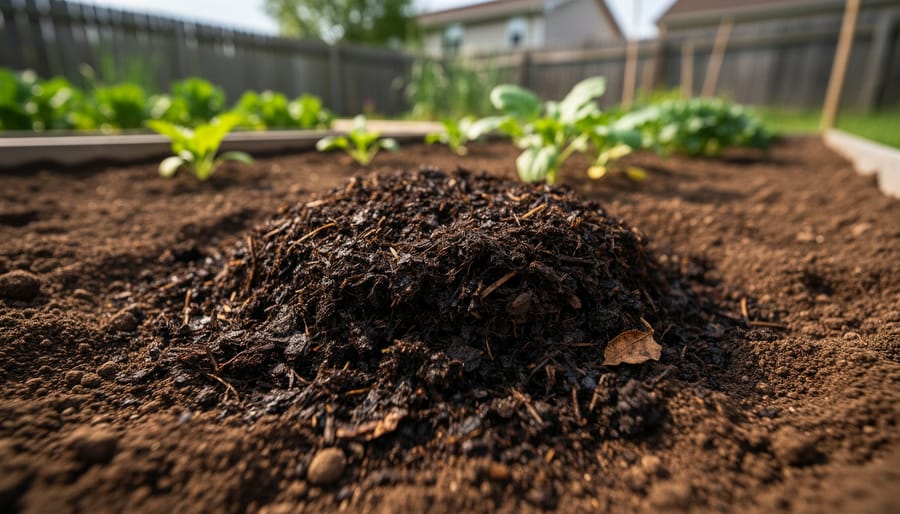
The core principles thread through everything: you work with nature’s rhythms and cycles, you build soil health as your primary task, you avoid synthetic chemicals that disrupt natural processes, and you create systems that regenerate themselves. On a commercial scale, this requires precise planning and significant knowledge. In my back garden, it meant starting with one principle, composting our kitchen waste, and gradually adding practices as I learned what my particular patch of earth needed.
How Organic Sustainability Works in Your Garden
The Soil Food Web: Nature’s Engine
I’ll be honest: when I first dug into my garden soil five years ago, it looked more like builder’s rubble than anything that could sustain life. Fast forward to last spring, and I pulled up a trowel of earth so dark and crumbly it reminded me of chocolate cake. That transformation wasn’t down to me adding bags of fertiliser, it was the soil food web doing its work.
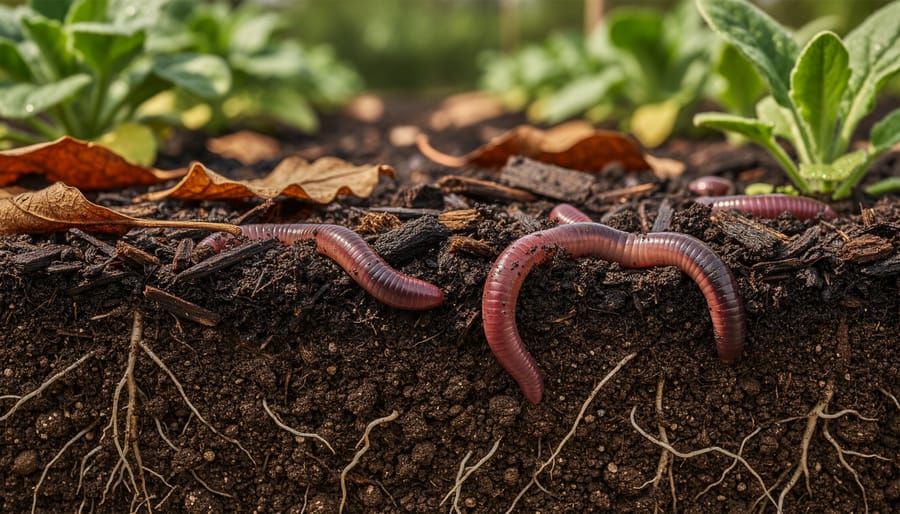
Think of your soil as a bustling underground city. Billions of bacteria, fungi, protozoa, and nematodes live in every handful, breaking down organic matter and making nutrients available to plant roots. Earthworms act as the engineers, tunneling through and mixing everything together. Research shows that earthworms and microbial activity work in tandem to transform organic material into plant-available nutrients far more effectively than synthetic inputs alone.
The beauty is that once you get this system going, it largely runs itself. I noticed real change in my second season when I stopped digging and started layering compost and mulch on the surface. The worm population exploded. They pulled the organic matter down, creating channels that improved drainage in my heavy clay while their castings enriched the soil.
Each autumn now, I spread a thick layer of home-made compost over my beds and let the soil life do the rest. By spring, it’s mostly disappeared, not because it’s washed away, but because it’s been processed into the living soil structure. My courgette plants tap into this fertility without me adding a single granule of anything. That’s the engine running.
Closing the Loop: From Garden to Compost to Table
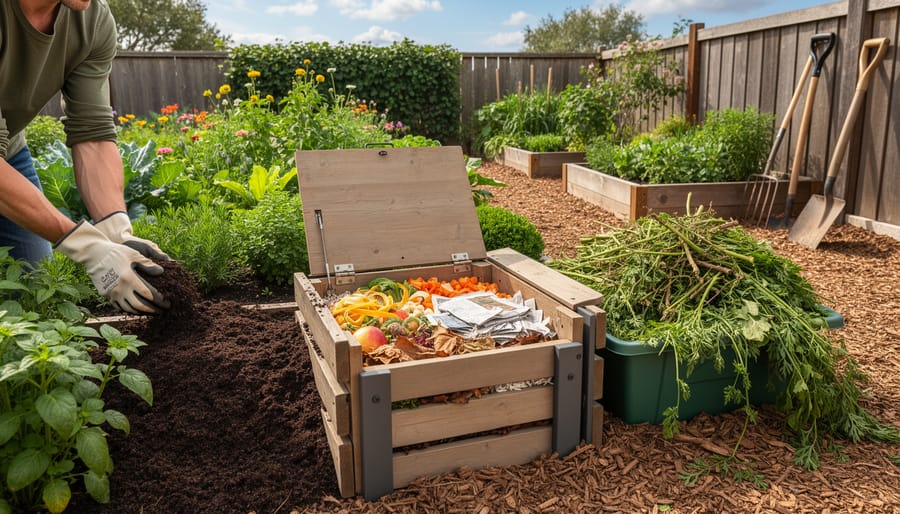
I’ll never forget the first time I truly understood composting wasn’t just about waste disposal, it was about creating actual wealth for my garden. I’d tipped a wheelbarrow of six-month-old compost onto a bed and watched steam rise from the dark, crumbly material. That was nitrogen, phosphorus, potassium, and dozens of trace minerals that had come from our kitchen scraps and pulled weeds. Nutrients I’d have otherwise bought in bags.
A closed-loop system means nothing leaves your property that could feed your soil. Potato peelings from Monday’s dinner become compost by summer, which grows next year’s potatoes, whose peelings return to the heap. The carrot tops you trimmed last week are already breaking down into the fertility that will grow this season’s courgettes. Garden waste, spent bean plants, bolted lettuce, autumn leaves, goes back into the cycle rather than to the council tip.
When we started composting properly, our bin collections dropped from weekly to fortnightly. More importantly, I stopped buying compost and fertilizer. The system supplies itself. You’re not just reducing waste; you’re eliminating the need for external inputs that cost money and carbon to produce and transport.
The beauty is its simplicity. Kitchen scraps provide nitrogen and moisture. Shredded cardboard and dry leaves provide carbon and structure. Microorganisms do the transformation. Time does the rest. Within months, you’re spreading what would have been waste onto beds as rich, living soil food. Nothing wasted, everything used, fertility building year after year.
Building Natural Resilience
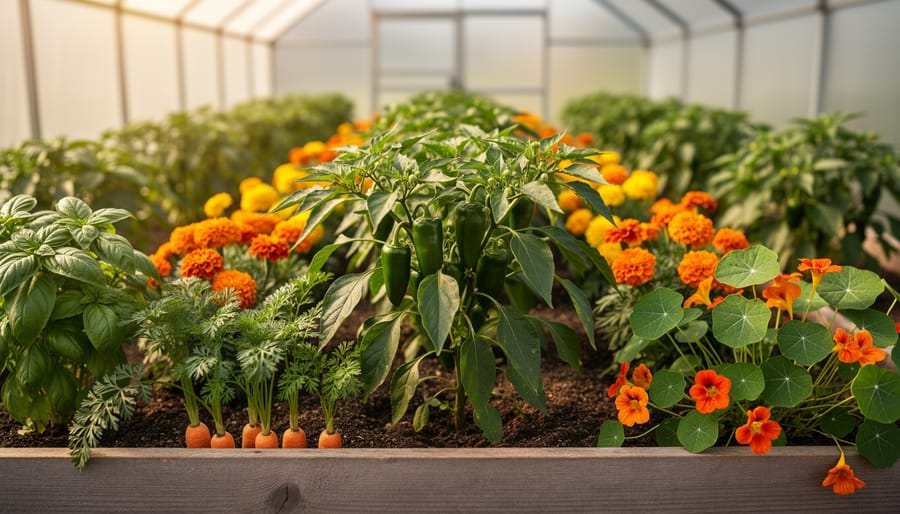
I learned about natural resilience the hard way when aphids decimated my first organic bean crop. I’d assumed that simply avoiding chemicals was enough, but my monoculture rows were an open invitation to pests. The next season, I scattered marigolds among the beans, planted nasturtiums as trap crops, and alternated my beds with brassicas. The difference was remarkable. The aphids arrived, but so did ladybirds, hoverflies, and lacewings drawn to the flowering plants. Damage stayed minimal, and I harvested more than I’d hoped.
This is companion planting in action, part of a larger strategy of creating resilience through diversity. Crop rotation prevents soil depletion and breaks pest life cycles, move your brassicas, legumes, and alliums around each year so diseases can’t establish. I now plan four-year rotations and keep records to avoid repeating crops in the same spot. Growing many varieties means if one fails, others thrive. My mixed beds confuse pests, support beneficial insects, and create a garden that largely looks after itself. No sprays needed, just patience and observation.
Core Components of a Sustainable Organic System
Soil Building Methods
I’ll never forget the first time I dug into my garden after a winter of composting and mulching. The soil that had been compacted clay just months before now crumbled in my hands, teeming with worms. That transformation taught me what soil building actually means.
Composting remains my cornerstone method. I keep two bins rotating: one decomposing while I fill the other with kitchen peelings, coffee grounds, and garden trimmings. The finished compost goes straight into planting holes and as a top dressing around established crops. It’s transformed my soil from something plants tolerated to something they genuinely thrive in.
Green manures were a revelation once I understood the timing. I now sow phacelia or field beans on any bed that’ll be empty for six weeks or more. Before they flower, I chop them down and leave them as mulch, or lightly fork them into the top few inches. They suppress weeds, prevent nutrient leaching during winter rains, and add organic matter when incorporated.
Mulching changed everything about moisture retention and weed control. I use whatever’s available: grass clippings between vegetables, straw around strawberries, leaf mould under fruit bushes. The soil stays cooler in summer, warmer in winter, and I spend far less time watering and weeding.
The no-dig approach came last, but now I barely touch my established beds. I simply add compost on top each spring. The worms do the incorporating, soil structure improves year after year, and I’ve cut my workload in half.
Creating Biodiversity
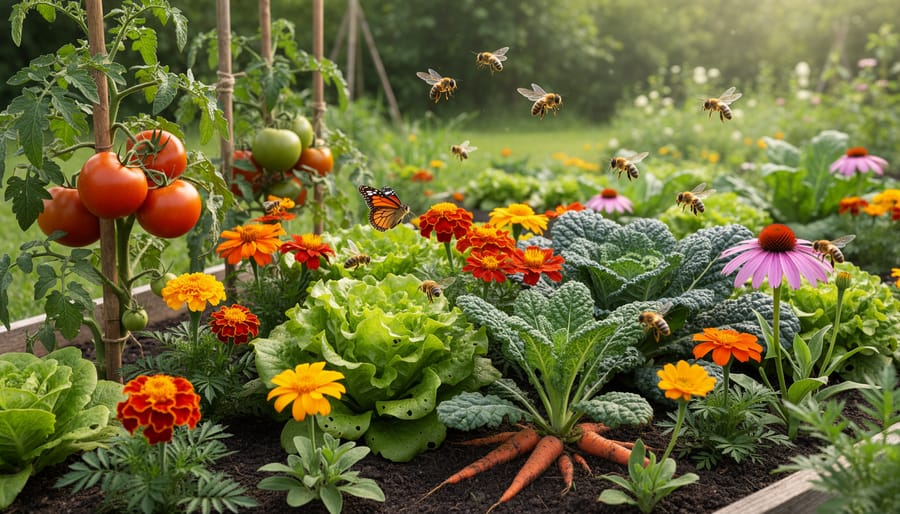
I learned the value of diversity the hard way when my mono-cropped courgette patch succumbed to powdery mildew three summers running. Now my vegetable beds weave together salad leaves, brassicas, alliums, and legumes, a living patchwork that confuses pests and spreads risk. Between the rows, I plant yarrow calendula, and nasturtiums, which draw in hoverflies and ladybirds that patrol for aphids far more reliably than I ever could with a spray bottle.
This variety does more than protect crops. The mix of flowers keeps pollinators visiting from early spring through autumn, improving yields on beans, courgettes, and soft fruit. Leaving a wild corner with nettles and brambles provides shelter for beneficial insects and hedgehogs that eat slugs. For the family table, diversity means something different every week, purple carrots, striped tomatoes, three kinds of kale, rather than gluts of the same veg. Children who help pick a rainbow of produce tend to eat it with more enthusiasm, I’ve found.
Resource Management
When I first started growing organically, I quickly learned that sustainability isn’t just about avoiding chemicals, it’s about using every resource cleverly. Water became my most precious commodity during the dry summers we’ve had lately.
I installed two water butts connected to the shed and greenhouse gutters, which now collect enough rainwater to see my beds through most dry spells. Positioning them near the plot saves lugging watering cans across the garden, and the slightly warmer rainwater seems kinder to plant roots than the shock of cold tap water.
Mulching transformed how I manage moisture. I spread a thick layer of homemade compost around crops each spring, which locks in moisture, suppresses weeds, and feeds the soil as it breaks down. Around fruit bushes, I use cardboard topped with wood chips, it keeps the ground damp underneath even during heatwaves.
For space, I’ve learned to think vertically. Climbing beans, cucumbers, and even squash trained up sturdy frames multiply my growing area without expanding the footprint. I also stagger plantings in the same bed: fast-growing salad leaves occupy the space between slower brassicas, making every square foot work harder. Observing where sunlight falls throughout the day helped me place heat-lovers like tomatoes in the brightest spots while shade-tolerant crops like lettuce thrive in the slightly darker corners.
Practical Applications for Family Food Growing
Planning a Year-Round Food Garden
The real breakthrough in my organic journey came when I stopped thinking about “spring planting” and started viewing my garden as a continuous production system. Year-round food supply isn’t about harvesting tomatoes in January, it’s about strategic planning that works with British weather rather than against it.
I map my garden in three overlapping waves. Spring and summer give us the classics: lettuces, peas, courgettes, and beans, with succession sowings every fortnight from March through July so we’re never overwhelmed or empty-handed. By learning proper gardening by seasons I discovered that late summer is actually planting time for winter staples. I now sow kale, purple sprouting broccoli, and winter cabbage in July and August, giving them months to establish before frost arrives.
Storage varieties changed everything. Maincrop potatoes lifted in September keep in hessian sacks until spring. Butternut squash cured on the windowsill last six months in our cool pantry. I dedicate a quarter of my beds to these workhorses: onions, garlic, beetroot, and carrots that bridge the hungry gap between February and May.
The third wave covers the genuine winter harvest: hardy greens like perpetual spinach, chard, and winter lettuce under cloches, plus leeks that stand through hard frosts. These don’t produce abundantly, but they provide fresh leaves when shop prices soar and our stored roots need supplementing.
Scaling to Your Family’s Needs
When I first started growing for my family of four, I wildly overestimated our courgette consumption and severely underplanted potatoes. We ate courgettes for breakfast by August, yet still bought spuds all winter.
The truth is, scaling an organic garden to your family’s needs takes observation more than mathematics. I learned to track what we actually eat over a month, not what I imagine we should eat. If we use two lettuces and a handful of tomatoes weekly, that’s my baseline for planting.
Start with high-value, frequently used crops: salad leaves, herbs, tomatoes, and runner beans. One 3-meter row of perpetual spinach kept us supplied for nine months, while three courgette plants produced far too much for four people.
For realistic self-sufficiency expectations, I aim to grow 40 percent of our summer vegetables and perhaps 15 percent year-round when preserving and storage are included. Complete self-sufficiency on a typical family plot is not just difficult, it’s a full-time occupation that conflicts with actually enjoying meals together. I’ve adjusted my goals from “growing everything” to “growing what makes the biggest difference to our table and budget,” which feels far more sustainable.
When Organic Meets Reality
I’ll admit my first year of purely organic growing was humbling. Aphids decimated my broad beans before I’d properly established ladybird habitat. My “closed-loop” compost system attracted rats. That perfect no-dig bed? Bindweed laughed at it.
These failures taught me that organic sustainability isn’t about rigid purity, it’s about honest adaptation. Some seasons I’ve bought in organic fertiliser when my compost couldn’t keep pace. I’ve hand-picked slugs at midnight while questioning my life choices.
Sarah Raven, who’s gardened organically at Perch Hill for decades, puts it perfectly: “Sustainable growing means building systems that work with your actual life, not some idealised version of it. Some years you’ll manage cover crops and three-bin composting. Other years, you’ll celebrate keeping anything alive.”
The goal isn’t perfection. It’s learning to transform your garden gradually into a more resilient, self-supporting system while feeding your family along the way. Progress, not purity.
Common Questions About Organic Sustainability
Over the years of writing about organic growing and chatting with readers at gardening events, I’ve heard the same questions come up again and again. These concerns are completely valid, they’re the same ones I wrestled with when I first started thinking seriously about sustainable food production. Let me address the most common ones based on both my experience and conversations with other family growers.
Is organic growing more expensive than conventional methods?
The startup costs can be higher if you’re buying compost and organic inputs, but a truly sustainable system becomes cheaper over time as you produce your own compost, save seeds, and build soil fertility naturally. My seed and input costs have dropped by about two-thirds since I started closing the nutrient loop in my garden.
How long before my garden becomes genuinely self-sustaining?
Most gardens show significant improvement within two to three growing seasons, though it depends on your starting soil condition and how consistently you apply organic principles. I noticed my soil holding moisture better and needing less intervention by the end of year two.
Can I realistically grow enough to feed my family?
Complete self-sufficiency is difficult in the UK climate without significant space, but most families can grow 30-50% of their vegetables with a well-planned garden. I focus on high-value crops like salads, tomatoes, and beans that are expensive to buy organic, rather than trying to grow everything.
Do I need to be 100% organic to see sustainability benefits?
Not at all, even adopting a few organic practices like composting kitchen waste or avoiding synthetic pesticides makes a meaningful difference. I started with just composting and gradually expanded as I learned what worked in my garden.
The pest question deserves particular attention because it’s what stops many families from trying organic methods. Without chemicals, you rely on prevention rather than cure. I’ve learned that healthy plants in good soil genuinely resist pests better, though this sounds like gardening folklore until you experience it yourself. Companion planting, encouraging beneficial insects with flowers, and accepting a small amount of damage as part of the natural balance all play a role. Hand-picking larger pests like caterpillars becomes routine rather than a chore when you’re out checking your crops daily anyway.
Space limitations concern many urban and suburban families, but I’ve seen remarkable production from tiny gardens. Vertical growing, succession planting, and choosing compact varieties stretch small spaces considerably. A friend grows enough salad, herbs, and cherry tomatoes for her family of four from three raised beds measuring just six feet by three feet. It won’t replace the supermarket, but it provides fresh organic produce throughout the growing season and connects her children to where food comes from, benefits that go beyond the harvest weight.
Looking back at my own journey into organic growing, I’m struck by how much has changed, not just in the garden, but in how my family relates to food itself. We didn’t transform overnight into self-sufficient homesteaders. We started with a single compost bin and a few tomato plants, making plenty of mistakes along the way.
What I’ve learned is that sustainable organic growing isn’t about achieving some perfect eco-ideal. It’s about making choices that move you toward greater independence and harmony with nature, one season at a time. Some years, the slugs win. Sometimes you need to buy vegetables because your carefully planned succession planting didn’t quite work out. That’s fine. What matters is the direction you’re heading, not the speed of travel.
The real transformation happens gradually. You notice the soil getting darker and more crumbly. You spot your first ground beetle patrol. You realize you haven’t bought salad leaves in months. Your children start requesting “the proper tomatoes” instead of supermarket ones. These small victories accumulate into something meaningful, a household that’s more resilient, more connected to the seasons, and genuinely more sustainable.
If you’re just starting, pick one practice that resonates with you. Start composting. Try companion planting. Plant a green manure crop. Each small step builds understanding and confidence for the next.
I’d love to hear about your own experiences with organic growing, whether you’re just beginning or years into the journey. What challenges have you faced? What surprised you? Drop your stories and questions in the comments, we’re all learning together.