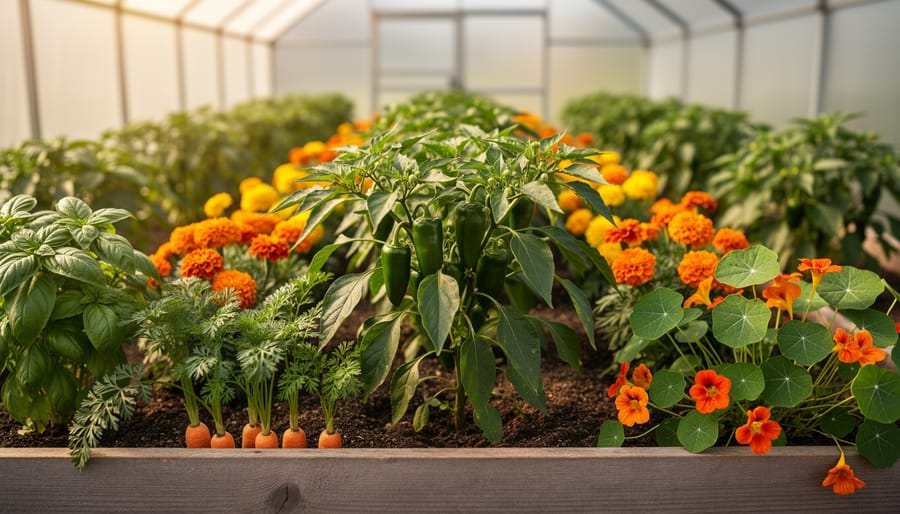
Last spring, I stood in my neighbour’s garden staring at what looked like beautiful anarchy. Where my own plot featured neat rows of carefully spaced courgettes and precisely positioned companion plants, hers was a riot of vegetables, herbs, and flowers growing wherever they pleased. “Chaos gardening,” she said with a grin. “I just scatter seeds and let them sort themselves out.”
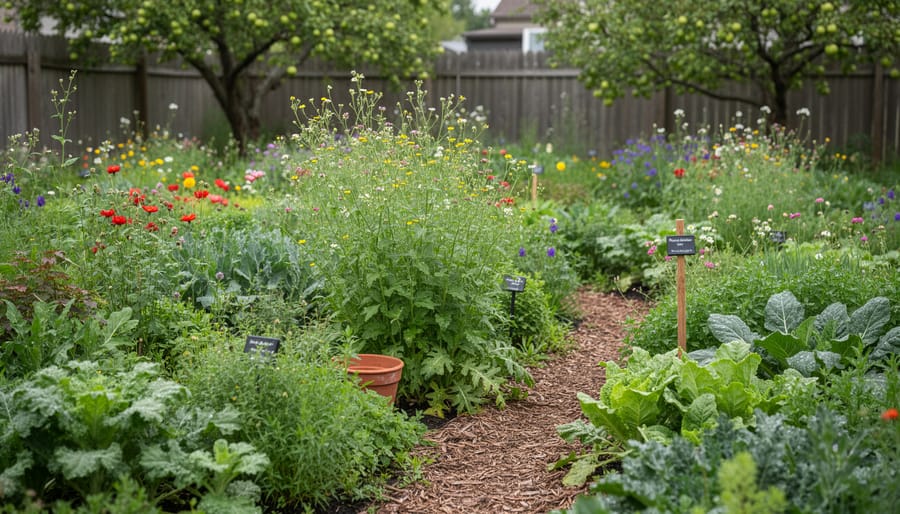
I’ll admit I was sceptical. After twenty years of following proper spacing guidelines and crop rotation schedules, the idea of tossing mixed seeds into a patch and walking away felt wrong. But her garden told a different story. Calendula bloomed between lettuces, borage sprawled over squash, and self-seeded tomatoes popped up in the most unexpected corners. The whole space hummed with pollinators.
Chaos gardening turns traditional growing methods on their head. Rather than planting in organized rows with measured spacing, you broadcast a mixture of vegetable, herb, and flower seeds across prepared soil and allow plants to establish themselves naturally. The strongest seedlings survive, plants find their own space, and the dense coverage suppresses weeds while creating a biodiverse mini ecosystem.
This isn’t just rebellious gardening for the sake of it. The method draws on principles from permaculture and forest gardening, mimicking how plants grow in nature without human intervention. Chaos gardening can actually reduce pest problems, and the reason is simple: “That diversity confuses pests and encourages beneficial insects. You’re creating complexity that works in your favour.”
The approach particularly suits time-poor gardeners and those working with challenging spaces. But does it actually produce food? That’s what I needed to find out for myself.
What Exactly Is Chaos Gardening?
Chaos gardening throws out the rule book I spent years following. Instead of carefully spaced rows, neat edges, and colour-coordinated beds, you scatter mixed seeds wherever feels right and let them sort themselves out. That’s it. No grid paper, no succession planting charts, no agonising over which companion goes where.
The approach centres on three core principles. First, random seed scattering rather than precise placement. You might toss calendula, lettuce, borage and radish seeds together across a patch and see what emerges. Second, minimal planning beyond choosing a general area and appropriate plants for your conditions. Third, embracing whatever happens next, whether that’s carrots popping up between cosmos or spinach thriving in unexpected shade.
Traditional gardening asks you to map everything out. You measure spacing, prepare perfect rows, thin seedlings to exact distances. You control the narrative from start to finish. Chaos gardening does the opposite. It trusts that plants know where they want to be better than you do, that some will outcompete others naturally, and that the resulting jumble will create its own logic.
This isn’t just laziness dressed up (though I won’t lie, it is less work). The philosophy stems from observing wild spaces where plants self-seed freely, finding their perfect microclimate without human intervention. A shaded spot you’d never consider for tomatoes might suit lettuce beautifully once taller plants create natural cover. That soggy corner could become a happy accident for moisture-loving herbs.
The hardest part? Letting go. Not jumping in to “fix” things when plants grow closer together than the seed packet recommends, or when they spread where you didn’t intend. Chaos gardening asks you to become an observer first, controller second. Nature generally knows what it’s doing if you give it space to work.
My First Chaos Gardening Experiment (And What Happened)
I still remember the April morning I decided to throw caution (and my carefully gridded garden plan) to the wind. After spending the previous three springs measuring spacing with string and labelling each row with meticulous little markers, I’d read about chaos gardening and thought, why not dedicate one raised bed to pure anarchy? I grabbed six seed packets from my shed, calendula, nigella, phacelia, wild rocket, nasturtium, and borage, ripped them all open, mixed the seeds in a bowl, and scattered them like I was feeding chickens. Then I covered them lightly with compost, watered, and walked away feeling oddly liberated and slightly irresponsible.
The first surprise came within ten days. While my neat rows in other beds showed predictable seedling lines, the chaos bed erupted in a joyful jumble. The rocket shot up fastest, creating a peppery green canopy that shaded smaller seedlings beneath. I worried I’d made a terrible mistake until I noticed the nasturtiums weaving between the rocket stems, their round leaves catching light in the gaps. By late May, the bed was a riot of colour and texture that genuinely looked better than anything I’d planned.
What worked brilliantly? The calendula and borage became best friends, their contrasting heights creating natural layers. The phacelia attracted more bees than I’d ever seen in one spot, buzzing over to pollinate my nearby courgettes. Harvesting rocket became an adventure rather than a chore, and the nasturtium flowers ended up in more salads than I’d anticipated.
The flop? Nigella, beyond my seed-scattering mishap, got completely bullied out by the more aggressive rocket and nasturtium. I found maybe three delicate seedlings that survived to flower, hidden in corners. I also underestimated how much the rocket would self-seed, by July, rocket seedlings were appearing in cracks in my patio two metres away.
The biggest lesson was about control. My neat beds required constant attention to keep them looking tidy, but the chaos bed sorted itself out. Stronger plants supported weaker ones, and the dense planting meant fewer weeds. I spent perhaps a quarter of the time on maintenance, and honestly, I enjoyed just watching it evolve rather than enforcing my vision on it.
The Benefits You’ll Actually Notice
Time Savings and Less Stress
I’ll admit the first benefit I noticed wasn’t some grand ecological revelation, it was getting my Sunday afternoons back. Before chaos gardening, I’d spend hours each weekend hunched over garden plans, measuring spacing with a ruler, and obsessing over whether my courgettes were precisely 90cm apart. Now? I scatter seeds while my coffee’s still warm and I’m done in twenty minutes.
The weeding changed too. With plants growing in unpredictable clusters rather than neat rows, I found myself caring far less about what constituted a “weed.” That self-seeded poppy growing between the lettuce and borage? It stays. The volunteer calendula nudging against the kale? Welcome to the party. When everything looks intentionally wild, you stop fighting nature’s choices and start letting beneficial plants simply coexist.
What surprised me most was the mental shift. I no longer panic when I can’t get to the garden for a week. There’s no rigid schedule screaming at me, no intricate plan falling apart if I miss a planting window. The garden just… carries on. Some seeds germinate late, others earlier than expected, and somehow it all works out. My shoulders literally dropped when I realized I didn’t have to be the garden’s micromanager anymore.
Natural Pest Control and Biodiversity
When I scattered that jumble of seeds last spring, I didn’t grasp I was actually applying the basics of companion planting without any charts or planning. The marigolds ended up beside my courgettes, nasturtiums sprawled near the beans, and calendula popped up everywhere. Within weeks, I noticed something remarkable: my usual aphid invasion never materialised. Instead, hoverflies and ladybirds patrolled the chaos, drawn by the diverse pollen and nectar sources that traditional row planting rarely provides.
This accidental ecosystem worked because nature doesn’t do monocultures. The random mix confused pests that typically target specific crops arranged in neat, predictable rows. Strong-scented herbs landed near vulnerable vegetables, masking their scent. Flowers attracted parasitic wasps that decimated caterpillar populations before I even spotted them. My garden became a self-regulating community where problems solved themselves through biological diversity rather than my intervention. That summer I used exactly zero pesticides and spent far less time inspecting leaves for trouble.

The Joy of Surprise
I’ll be honest: the first morning I walked out to discover a cosmos had planted itself next to my courgettes, I laughed out loud. Not the polite chuckle you give a mediocre joke, but proper belly laughter at the sheer audacity of nature’s placement. That cosmos had no business being there according to my old garden plans, yet it looked absolutely perfect waving its pink petals above the broad leaves.
This is the gift chaos gardening keeps giving. Each morning becomes a treasure hunt. What germinated overnight? Which seedling appeared in the gravel path? Where did that poppy decide to claim its territory? The anticipation pulls me outside before my first coffee, something years of regimented garden planning never managed. I’ve noticed it genuinely helps improve sleep quality too, because I’m actually excited to wake up and see what’s happened.
The mental shift matters more than I expected. Letting go of control, accepting that a nasturtium might sprawl across your neat herb patch, trains you to find beauty in the unplanned. My shoulders literally dropped the day I stopped fretting about whether the calendula was in the “right” spot. It wasn’t about lowering standards; it was about raising my capacity for delight.
Better Soil Health
My chaos patch taught me something I hadn’t expected: the soil became noticeably richer and more crumbly within just one season. When plants grow in random clusters rather than neat rows, their different root structures naturally break up compacted soil at varying depths. Legumes fix nitrogen wherever they pop up, whilst leafy greens and brassicas draw up different minerals. This haphazard diversity means no single area gets depleted of specific nutrients, unlike traditional vegetable beds where you plant the same crop family in the same spot. The effect resembles understanding green manure principles, but it happens organically through mixed planting rather than planned rotation. When harvest time comes and spent plants decompose in place, they return varied organic matter throughout the bed, creating a natural feeding cycle that keeps improving year on year.
How to Start Your Own Chaos Garden
Starting a chaos garden is refreshingly simple, which rather defeats the years I spent agonising over garden plans. Here’s how I approached my first attempt, refined through several seasons of joyful disorder.
Choose your chaos zone first. I started with a 2-metre-square patch near my shed, somewhere I could observe daily without committing my entire garden to the experiment. If you’ve got build a raised bed recently, that’s brilliant for chaos gardening because the contained space prevents complete mayhem whilst still offering plenty of creative disorder. Alternatively, clear a neglected corner or use that awkward strip alongside the fence where nothing seems to thrive anyway.
Prepare the soil minimally. Chaos gardening doesn’t mean dumping seeds onto concrete. I cleared the worst weeds, loosened the top few inches with a fork, and raked in a bit of compost. That’s it. No creating a perfect soil circle with precise nutrient ratios. The aim is good-enough ground that gives seeds a fighting chance.
Select your seeds with intention, ironically enough. I chose mostly hardy annuals and self-seeders: calendula, cornflowers, love-in-a-mist, California poppies, borage, mixed salad leaves, radishes, and nasturtiums. Pick varieties known to germinate easily and tolerate UK weather variability. Avoid anything requiring specific spacing or depth like parsnips or sweetcorn. Mix your seeds together in a bowl before scattering, which creates better distribution than tossing individual packets.
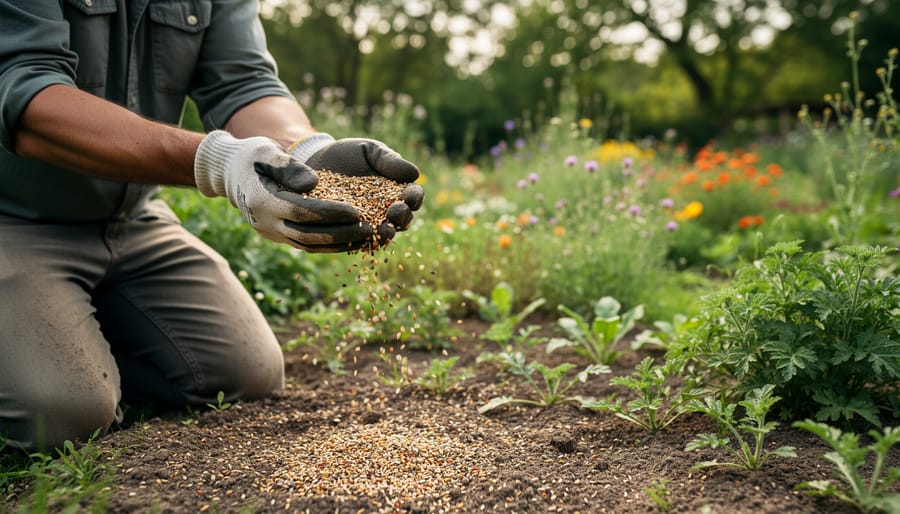
The scattering technique matters more than I’d expected. Don’t just chuck handfuls and hope. I scattered seeds in broad, sweeping motions across the entire area, making several passes to ensure reasonable coverage. Then I walked the plot, gently pressing seeds into contact with soil using my feet. Some gardeners rake lightly afterwards, but I found that disturbed the random placement too much.
Water gently but thoroughly after sowing. I used a watering can with a rose attachment to avoid washing seeds into clumps. Keep the area consistently moist until germination begins, usually seven to fourteen days depending on weather.
Here’s where patience becomes crucial. The first few weeks look like nothing’s happening, then like weeds are winning, then suddenly you’ll spot your chosen seedlings emerging amongst everything else. Resist the urge to tidy or thin too aggressively. I learned to recognise seedlings early and pulled only obvious thugs like bindweed or dandelions.
Let nature handle most decisions from there. Some plants will dominate, others will sulk. That’s precisely the point. I watered during particularly dry spells and removed anything clearly dead, but otherwise left my chaos patch to sort itself out. The resulting garden looked nothing like I’d imagined, which made it absolutely perfect.
Best Plants for Chaos Gardening in the UK
After months of trial and error, I’ve learnt which plants actually deliver in a chaos garden without demanding constant attention. The secret lies in choosing self-sufficient varieties that compete well with neighbours, tolerate variable conditions, and often self-seed for next year’s chaos.
**Vegetables That Thrive in Chaos**
Broad beans have been my surprise champion. Scatter them in autumn or early spring, and they’ll establish themselves wherever they land, fixing nitrogen for neighbours as a bonus. Chard is equally forgiving, it tolerates crowding, produces for months, and handles both sun and partial shade without complaint.
Calendula, borage, and nasturtiums form the backbone of any chaos flower selection. They self-seed reliably, suppress weeds through sheer vigour, and attract pollinators by the dozen. I scattered calendula seeds three years ago and haven’t deliberately planted them since, they return faithfully each spring, popping up in new combinations that somehow always look intentional.
| Plant | Type | Why It Works | Season |
|---|---|---|---|
| Broad Beans | Vegetable | Hardy, nitrogen-fixing, self-supporting in groups | Autumn-Spring |
| Calendula | Flower | Self-seeds prolifically, edible, attracts beneficials | Spring-Autumn |
| Borage | Herb/Flower | Vigorous self-seeder, excellent pollinator plant | Late Spring-Autumn |
| Chives | Herb | Perennial, clump-forming, pest-deterrent flowers | Year-round |
| Phacelia | Flower | Fast-growing, soil-improving, bee magnet | Spring-Summer |
For herbs, chives and fennel establish themselves permanently once scattered, returning stronger each year. Both flower beautifully and confuse pests with their strong scents. Coriander works brilliantly if you let it bolt, the flowers feed beneficial insects whilst seeds drop for next season’s crop.
Phacelia deserves special mention as the ultimate chaos companion. This fast-growing green manure flowers within weeks, attracts hoverflies and bees, then dies back to enrich the soil. I scatter it liberally between everything else.
**What to Avoid**
Skip anything needing precise spacing (Brussels sprouts, cauliflower), regular training (tomatoes, runner beans), or specific soil preparation (carrots in heavy clay). Save those for your structured beds and let the chaos garden handle the self-sufficient rebels.
When Chaos Gardening Isn’t the Answer
I’d be lying if I told you chaos gardening works for everything in my garden. Last year, I tried the scattergun approach with my prized asparagus bed, and frankly, the results were dismal. Some crops and garden features simply demand structure, planning, and disciplined maintenance.
Trained fruit trees need annual pruning at specific times to develop proper framework and fruiting spurs. You can’t scatter apple seeds and hope for an espalier against your sunny wall. Stone fruit requires particular attention to prevent disease, and grape vines must be systematically trained to produce decent harvests. These plants represent long-term investments that chaos would undermine.
Root vegetables present another challenge. While carrots might tolerate random sowing, parsnips need deep, stone-free soil you’ve prepared deliberately. Growing exhibition onions for the village show? Those need spacing, feeding schedules, and careful cultivation. Chaos won’t cut it.
Formal gardens remain firmly off-limits. A pristine lawn demands regular mowing patterns, edging, and weed control. Topiary requires patience and precision. Herbaceous borders designed around colour schemes and flowering succession fall apart without thoughtful planning and placement.
Crops needing protection fail under chaos methods too. Brassicas become cabbage white buffets without netting. Soft fruit disappears into bird bellies. Tender vegetables like tomatoes and peppers need greenhouse conditions and training in most UK gardens.
I’ve learned to divide my space: chaos in the cottage garden borders and cutting patches, structure in the vegetable beds and fruit area. This hybrid approach lets me enjoy the spontaneity I love while still harvesting crops that actually need my intervention. Some plants are simply too valuable, too demanding, or too specific to leave entirely to chance.
Expert Insights: Lessons from Long-Time Chaos Gardeners
My couple of seasons is only a start, so here are the lessons that gardeners who have practised “intentional chaos” for years tend to come back to.
Many chaos gardeners stumble into it by accident: too many seed packets one spring, no time to draw up the usual meticulous planting plan, so everything gets scattered in rough guilds to be sorted out later. That ‘later’ often never comes, and the result can be the most productive, beautiful space they’ve ever had.
The biggest shift is realising you’re collaborating with your garden, not dictating to it. Once you stop fighting for control, everything gets easier.
The best approach combines chaos with just enough structure to avoid genuine disaster. Divide your space into “chaos zones” and keep a few traditional beds for crops that genuinely need attention, like tomatoes and trained cucumbers. Start small: pick one bed, maybe two square metres, and go wild. See what happens. You can always expand next year.
One tip is easy to overlook: keep a simple photo diary on your phone. You won’t remember where anything came up or what worked brilliantly together, so snap pictures every few weeks through the season. Next year, you’ll have a visual guide to what thrived and can weight your seed mix accordingly.
Expect some failures, too. Scatter brassicas in with everything else and cabbage whites can decimate them; chaos-plant them instead in their own dedicated area where you can net them easily. You learn where chaos works and where you need boundaries.
The most valuable lesson of all: don’t let chaos become another rigid rule. Some years you’ll plan more, some years you’ll scatter everything. The freedom is in choosing what serves you each season, not in proving you can be completely hands-off.
Looking back over my own journey with chaos gardening, I’ve come to see it as more than just a technique. It’s part of a broader shift in how we relate to our gardens and, perhaps, to life itself. When we let go of the need to control every seedling and square inch, we make space for something richer: a garden that breathes, surprises, and teaches us patience.
This approach doesn’t replace everything you know about gardening. Rather, it complements it. You can still have your carefully tended rose bed or your pristine herb spiral. Chaos gardening simply offers an alternative for those corners where perfection feels exhausting, where you crave connection more than control.
I’d encourage you to start small. Pick one neglected patch, scatter some seeds this spring, and see what emerges. You might discover plant combinations you’d never have planned. You might find yourself spending less time fretting over spacing charts and more time simply being present in your garden. That shift alone is worth the experiment.
The gardens that bring us the most joy aren’t always the ones that look like magazine spreads. They’re the ones where we feel something: wonder at a volunteer poppy in an unexpected spot, delight at the bees crowding around self-seeded borage, relief that we didn’t spend Sunday afternoon with a ruler and string.
I’d love to hear how your own chaos gardening experiments unfold. What surprises you? What fails spectacularly? Every scattered seed tells a story, and I’m genuinely curious about yours. Drop me a comment or reach out through the site. Let’s embrace the beautiful, unpredictable mess together.