I stood in my allotment last spring, staring at a freshly built raised bed and holding sixteen lettuce seedlings meant for a space that should comfortably hold nine. That’s when I finally understood why experienced gardeners swear by square foot gardening charts.
A square foot gardening chart tells you exactly how many plants fit in each one-foot square section of your growing space, and it’s transformed how I plan every bed. Instead of guessing or overcrowding (my former specialty), I now know that carrots go 16 to a square, tomatoes need the whole square to themselves, and radishes pack in at 16 per section. This method, pioneered by Mel Bartholomew decades ago, divides raised beds into grid squares and assigns each plant a specific spacing based on its mature size.
The beauty lies in its simplicity. You’re not measuring inches between plants or worrying about row spacing. You think in squares. One tomato plant per square. Four lettuces. Sixteen radishes. It’s kindergarten-level maths applied to gardening, which is precisely why it works so brilliantly for beginners and why I’ve watched seasoned gardeners at my local allotment society convert their traditional rows into grids.
But here’s what nobody tells you when you first search for these charts online: not all spacing recommendations match UK growing conditions, and American sources dominate the search results. I learned this the hard way when my courgettes, planted at the recommended one-per-square spacing from a US chart, still managed to stage a territorial takeover of three neighbouring squares by July.
Over the past three seasons, I’ve tested and adjusted my spacing to learn about what actually works in British gardens. What follows is everything I wish I’d known before planting those sixteen lettuces in 2024.
What a Square Foot Gardening Chart Actually Does (And Why You Need One)
I still remember the spring I planted six courgette seedlings in a single square foot, thinking I was being efficient. Within weeks, they’d turned into a tangled jungle of leaves fighting for light, producing exactly two small courgettes between them before the whole lot succumbed to powdery mildew. That disaster sent me hunting for a proper square foot gardening chart, and honestly, I wish I’d found one sooner.
A square foot gardening chart is essentially a spacing guide that tells you exactly how many plants of each type will fit in a one-foot-by-one-foot section of your raised bed. The chart uses the plant’s mature size as the key factor, not the tiny seedling size that fools most of us. My six courgettes should have been one plant per square, giving it the full foot of space its leaves and roots would eventually need. The chart would have shown me that immediately.
The beauty of mature-size plant planning is that it prevents the overcrowding that killed my courgettes and countless other plantings before I got wise. When plants have adequate space, air circulates properly around their leaves, reducing fungal diseases. Roots don’t compete as fiercely for nutrients and water. Each plant gets sufficient sunlight rather than reaching desperately through a canopy of neighbors.
The yield improvements surprised me most. That same bed now holds one courgette plant, four lettuce, and sixteen radishes across three squares, and I harvest far more than when I’d crammed it full of whatever took my fancy. The chart forced me to think strategically about which plants deserved precious space based on what we actually eat, and it showed me where I could tuck fast-growing crops like radishes alongside slower growers.
Once you understand the chart’s logic, planning becomes straightforward rather than guesswork.
Decoding the Numbers: How Many Plants Per Square?
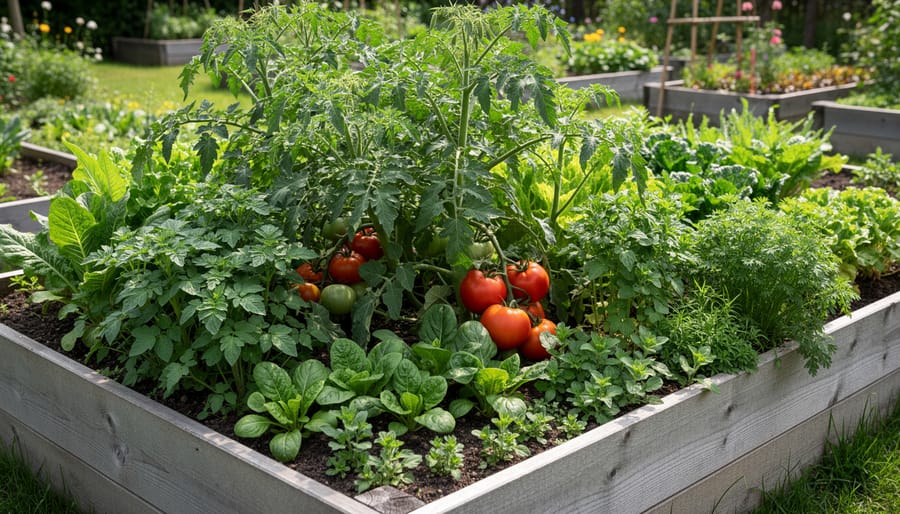
When I first sat down with my square foot gardening chart, I’ll admit I stared at it like it was written in code. The numbers seemed arbitrary, 1, 4, 9, 16, until I realized they were telling a story about plant size and spacing that would transform how I used every inch of my raised beds.
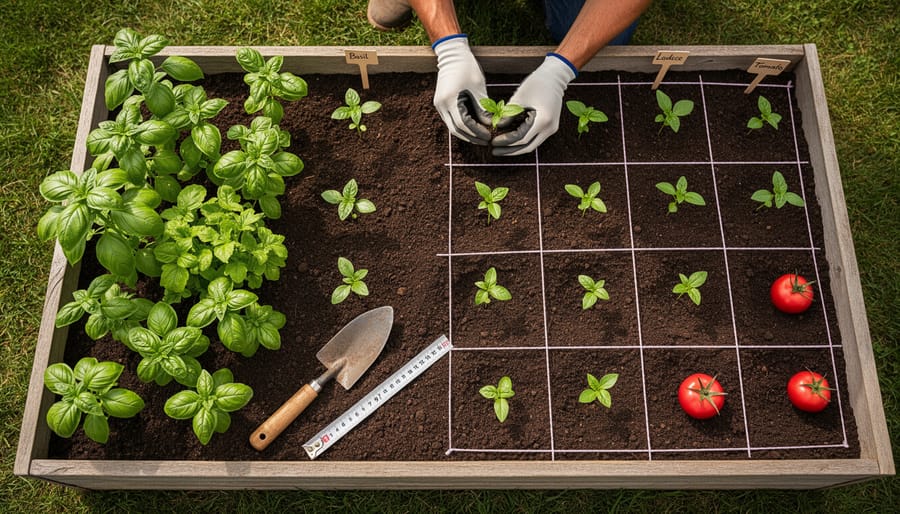
The logic is beautifully simple once you grasp it. The 1, 4, 9 or 16 rule corresponds to how much elbow room each plant needs at maturity. One plant per square foot means that veggie needs the full 12 inches to spread. Four plants means each gets a 6-inch square. Nine plants divide the square into a 4-inch grid. Sixteen plants squeeze into a 3-inch spacing, perfect for quick-growing crops you’ll harvest young.
I learned this the hard way with courgettes. My first year, I enthusiastically planted four courgette seedlings in one square, thinking I’d quadruple my harvest. Instead, I got a tangled mess of competing vines, meager fruits, and a valuable lesson about respecting plant spacing.
| Plants Per Square | Spacing Pattern | Common UK Vegetables & Herbs | Layout Description |
|---|---|---|---|
| 1 | 12 inches apart | Tomatoes, courgettes, peppers, cabbage, broccoli | Single plant centered in the square |
| 4 | 6 inches apart | Lettuce, chard, basil, parsley, French marigolds | Four plants in a grid pattern |
| 9 | 4 inches apart | Beetroot, turnips, spinach, bush beans | Three rows of three plants |
| 16 | 3 inches apart | Radishes, carrots, spring onions, coriander | Four rows of four plants |
The spacing isn’t just about fitting plants in, it’s about giving them what they need to thrive. My tomato plants need that full square because their root systems sprawl and their foliage spreads wide. I’ve grown cherry tomatoes successfully at this spacing, staking them vertically to maximize my limited bed space.
In contrast, my radishes practically beg to be planted at sixteen per square. They’re in and out in three weeks, their slim taproots barely interfering with each other. I’ve found this works brilliantly for succession planting, I can harvest a square of radishes and immediately replant with baby lettuce at four per square.
The four-per-square category has become my favorite for herbs. Last season, I planted basil in this pattern and had enough for pesto all summer without the plants feeling cramped. Each basil had room to bush out properly, and I could harvest from the four plants on rotation.
One trick I’ve discovered: the chart gives you starting points, not rigid rules. My carrots, theoretically a sixteen-per-square crop, do better at nine per square in my heavy clay-amended soil. They need that extra breathing room to develop straight roots. Your mileage may vary depending on your soil quality and microclimate, which is why keeping notes matters.
The Essential Plants for Your UK Square Foot Garden
Vegetables That Thrive in One Square
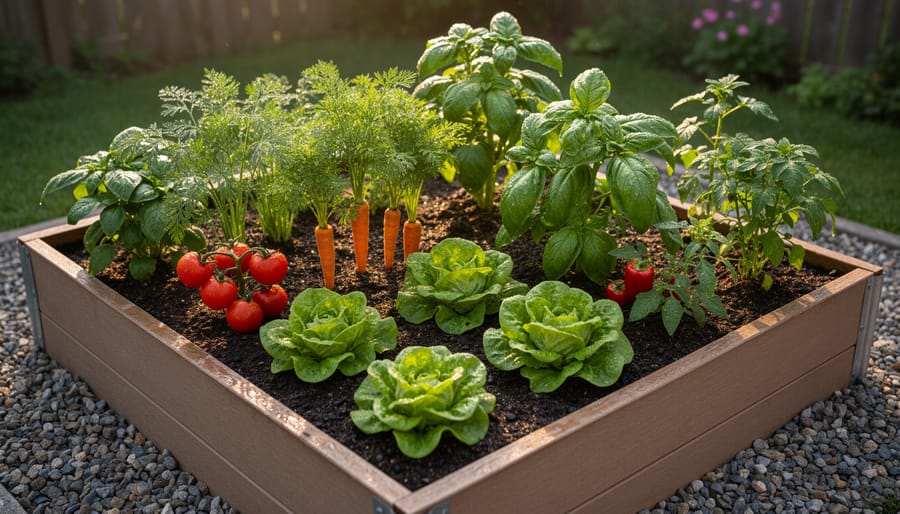
When you dedicate a full square to a single plant, you’re making room for the heavy hitters. Last spring, I planted ‘Sungold’ cherry tomatoes in four squares of my raised bed, and by August those four plants were producing more fruit than my family could eat. The one-per-square rule accounts for these plants’ extensive root systems and canopy spread at maturity.
Tomatoes are the classic example, though I’ve learned to stake or cage them immediately to keep their growth vertical rather than sprawling into neighboring squares. Courgettes (or zucchini if you prefer the American term) also command their own square. I grew ‘Defender’ last year, and a single plant kept us in courgettes from July through September. The leaves get enormous, easily shading out anything nearby.
Peppers occupy one square too, whether you’re growing sweet bells like ‘Gypsy’ or chili varieties. I tuck basil into an adjacent square since the companion planting basics suggest they’re excellent neighbors. Aubergines, calabrese (heading broccoli), and cauliflower all fall into this category as well. These plants need the space, but the payoff in yield per square is substantial when you give them room to thrive.
Making the Most of Compact Growers
The real space-savers in my garden are the plants that fit snugly alongside one another, four, nine, or even sixteen to a square. These compact growers transform a single raised bed into a proper harvest machine.
Lettuce has become my succession planting workhorse. I tuck nine plants per square, sowing a fresh batch every fortnight from March through September. By the time one square is ready for picking, the next is halfway grown. The same rhythm works brilliantly with radishes, which I plant sixteen to a square and harvest within four weeks, freeing up space for something slower.
Carrots are trickier. While the charts say sixteen per square, I’ve found nine gives me better-sized roots in my clay-heavy soil. Spring onions work at sixteen per square, though if you deal with onion sets for bulbing types, drop that to nine.
Herbs fit beautifully into this system. Basil, coriander, and parsley each take four plants per square, giving me constant snips for cooking. I’ve learned to plant half squares of fast-growing rocket (nine plants) alongside slower neighbors, maximizing every inch while the courgettes are still settling in.
Where to Find Reliable Square Foot Gardening Charts in 2026
When I first started square foot gardening, I spent hours trawling Pinterest for conflicting spacing information before realizing I needed proper, reliable sources. Let me share the resources that have genuinely helped me plan successful beds.
The gold standard remains the Square Foot Gardening Foundation’s materials. They’ve recently released the 4th edition of Square Foot Gardening, an updated and revised version of All New Square Foot Gardening. I keep my dog-eared copy on the potting bench rather than the bookshelf because I reference it constantly when planning new beds. The foundation also offers The Square Foot Gardening Planner, a three-year journal for recording your garden’s planning, planting, and care. I’ve found the journal format particularly useful for tracking what worked in previous seasons, especially important given our unpredictable British weather.
For free digital resources, the Almanac’s Square-Foot Garden Plot Plan has become my go-to for quick reference. Their 4×7 layout is part of a free library of tested raised bed garden layouts, and I’ve printed it out to laminate for weather-resistant use in the garden. It saves me from repeatedly washing soil off my phone screen when I need to check spacing mid-planting.
The most comprehensive online chart I’ve discovered is Garden In Minutes’ Ultimate Square Foot Gardening Guide & Plant Spacing Chart, which covers over 60 plants. This has been invaluable when I’ve wanted to try something new or verify spacing for less common vegetables. Similarly, Growers Guide offers a spacing chart for 30-plus vegetables that clearly shows whether each needs 1, 4, 9, or 16 plants per square.
Honestly, I started with the free Almanac plan and gradually invested in the official book once I knew the method suited me. The book provides context and problem-solving advice that charts alone can’t offer, but the free resources are perfectly adequate if you’re testing the waters with your first bed.
How I Use My Square Foot Chart in Practice
Every January, I sit down with a cup of tea, my battered copy of the Square Foot Gardening Foundation’s guide, and a printout of the Almanac’s 4×7 layout plan spread across the kitchen table. This year’s planning session for my 2026 season started with a family discussion over Sunday lunch. My daughter requested more cherry tomatoes for her lunchbox, my husband wanted enough basil to keep his weekend pasta habit going, and I was determined to grow enough salad leaves to stop buying those plastic boxes from the supermarket.
With those priorities scribbled in my gardening notebook, I turned to my spacing chart and started mapping out Bed Three, the sunniest spot in my garden. I knew from experience that the tomatoes had to go there, but I wanted to squeeze in companion plants too.
My planning process follows the same steps each year:
- List what we actually eat regularly and cross off anything that failed miserably last season (goodbye again, aubergines).
- Note the number of plants needed based on our consumption, not what sounds impressive.
- Group plants by their spacing requirements using the chart, starting with the ones that need full squares.
- Sketch the bed layout on graph paper, one square per actual square foot, placing tall plants on the north side so they won’t shade shorter neighbours.
- Fill gaps with quick-growing crops like radishes or lettuce that can be succession planted through the season.
For Bed Three this year, I allocated two squares to cordon tomatoes trained up bamboo canes, leaving enough room to actually harvest them without crushing other plants. Four squares went to basil planted at nine per square, which sounds crowded but works brilliantly when you harvest regularly. The remaining squares got a mix of compact lettuce varieties and spring onions, sixteen per square, which I can replant every three weeks for continuous harvests.
The chart stopped me making last year’s mistake of cramming in courgettes alongside everything else. Those monsters need their own dedicated square, lesson learned. Having the spacing laid out clearly means I can be realistic about what fits, rather than optimistically shoving in extra plants and hoping for the best.
Adapting Spacing Charts to British Conditions
The American charts are brilliant starting points, but British summers are simply different. We get more rain, cooler nights, and less intense sun, which affects how plants fill their allotted space.
Charts give you the framework, but you still need to observe your own microclimate. It’s a reminder that even the best chart is a guide, not gospel.
Common Questions About Using Square Foot Garden Charts
Over the years, I’ve fielded countless questions about square foot gardening charts from fellow gardeners at allotment meetings and through online forums. The beauty of this system lies in its simplicity, yet certain practical puzzles crop up repeatedly when people start implementing it in their own patches.
The most common head-scratcher I encounter involves irregular bed shapes. Not everyone has perfectly square or rectangular beds, and that’s absolutely fine. I measure my odd-shaped raised bed by mentally dividing it into the largest possible grid of complete squares, then use partial squares along the edges for smaller plants or herbs. A triangular corner might fit three radishes instead of four, or a curved edge could accommodate a single basil plant. The chart gives you the ideal spacing, but gardening has always been about working with what you’ve got.
Can I succession plant in the same square?
Absolutely, and I do this all the time with quick growers like lettuce and radishes. Once you harvest, refresh the compost, add a handful of organic fertilizer, and replant according to the chart spacing for your next crop.
Do American charts work for UK growing conditions?
The spacing remains accurate because it’s based on mature plant size, but I adjust timing and variety choices for our climate. What changes is when you plant and which cultivars tolerate our cooler, wetter summers.
How do I handle vertical growers like beans and cucumbers?
These still occupy their designated square at ground level, but they grow upward on supports. I plant climbing beans at four per square, then train them up bamboo canes or netting positioned at the bed’s north side to avoid shading other plants.
What if my plants are overcrowded despite following the chart?
This usually happens when we don’t thin seedlings properly or when plants receive excessive shade and stretch. Thin ruthlessly to the recommended number per square, ensure adequate light, and remember to water in extreme heat to prevent stress-induced bolting that makes plants lankier than expected.
Another practical consideration involves timing and seasonality. The charts show what fits where, but in Britain’s unpredictable climate, you’ll need to adjust planting windows. I’ve learned that courgettes marked as one per square in June might struggle if planted too early in our cooler springs, while winter salads can be packed more tightly when grown under fleece.
When it comes to root crops like onions, the chart spacing works brilliantly, but success depends on proper technique throughout the season. Once you’ve grown them at the recommended spacing, make sure you harvest onions properly to maximize storage life and avoid waste. I’ve found that four onions per square gives each bulb enough room to size up nicely without competing for nutrients.
The question of companion planting also comes up frequently. While square foot charts focus purely on spacing, I sometimes adjust my grid to pair beneficial plants. Carrots and spring onions share a square happily in my experience, with the onions helping deter carrot fly. The chart becomes a starting framework rather than rigid gospel once you gain confidence.
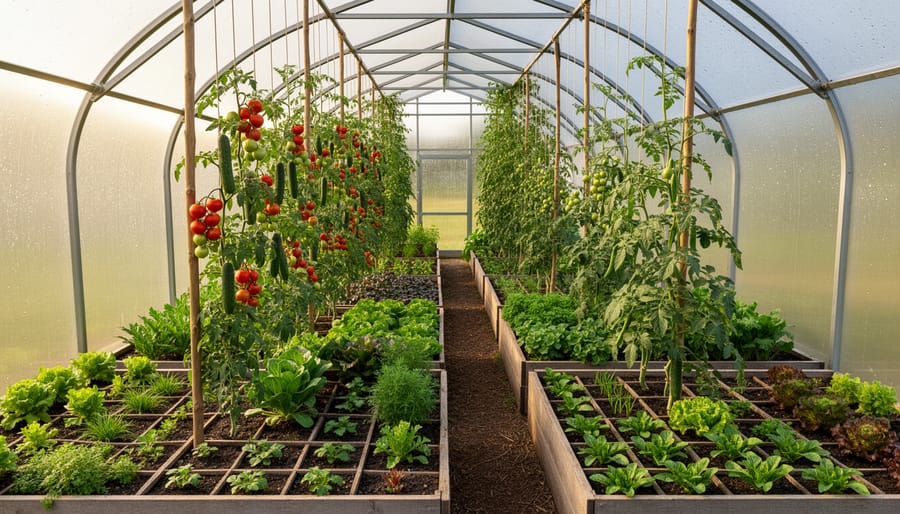
Looking back over the past few seasons, I can honestly say that discovering the square foot gardening chart changed everything about how I approach my limited garden space. Those early mistakes, cramming too many courgettes into a bed, watching lettuce bolt from crowding stress, taught me the value of respecting what the chart actually tells you about plant spacing. These days, my yields have doubled simply because each plant gets the room it needs to thrive.
If you’re just starting out, don’t feel overwhelmed by all the detailed charts and planning systems available. Begin with a basic spacing guide, mark out your squares with string or wooden dividers, and plant according to those simple numbers. You’ll quickly develop an instinct for what works in your particular microclimate and soil conditions. I’ve tweaked the standard recommendations countless times based on what I’ve observed in my own beds.
The beauty of this system is that it grows with you. One season you might stick rigidly to the 1-4-9-16 formula; the next, you’re experimenting with vertical supports, succession planting, or even understanding green manure to refresh your squares between crops. It’s endlessly adaptable.
I’d genuinely love to hear how you get on with your own square foot garden. Which vegetables have surprised you? Have you modified the standard spacing for UK conditions? Drop a comment below or connect with me, there’s always something new to learn from fellow gardeners who are making the most of every precious square.