Grey gardening transforms a border from ordinary to extraordinary by weaving together plants with silver, pewter and dove-grey foliage to create luminous focal points that glow in morning light and soften harsh summer sun. The technique works because grey-leaved plants reflect rather than absorb light, making small spaces feel larger and creating visual breathing room between bold colours. I stumbled into this approach by accident three summers ago when a stretch of my south-facing border looked washed-out and tired. A gardener friend visiting from Sussex took one look and said, “You need more grey.” She was absolutely right.
The magic lies in understanding that grey foliage does three jobs at once: it cools down hot colour schemes, highlights nearby blooms, and brings drought tolerance to challenging spots since most silver-leaved plants have evolved to thrive in lean, dry conditions. That’s why you’ll find them clothing Mediterranean hillsides and rocky coastal cliffs. In British gardens, they’re equally at home but need sharp drainage to prevent winter rot.
I’ve since learned from Chelsea medal-winner Sarah Raven that the best grey gardens layer different textures rather than relying on colour alone. Felted lamb’s ears sit beside spiky sea holly, while artemisia’s feathery plumes contrast with the architectural leaves of cardoons. The result feels deliberate yet effortless, a look that’s proved surprisingly forgiving for someone who once killed lavender through kindness.
Why Grey Gardening Works
I stumbled into grey gardening almost by accident. After planting a few lavender bushes along my path one spring, I noticed how they seemed to make everything around them look brighter and more vibrant. The silvery leaves caught morning light in a way that green foliage simply didn’t, and suddenly those purple salvias and pink roses nearby appeared more intense. That observation changed how I approached colour and texture in my borders.
The magic of grey plants lies in their reflective quality. Silver foliage reflects light rather than absorbing it, creating subtle shimmer that lifts entire planting schemes. On overcast days (and we have plenty of those in Britain), grey plants prevent borders from looking flat and dull. They act as visual punctuation marks, giving the eye places to rest between bolder colours. I’ve watched visitors to my garden naturally gravitate toward areas where I’ve woven in artemisia or stachys, even if they can’t articulate why those spots feel more balanced.
There’s a practical side too. Most grey-foliaged plants evolved their colouring as protection against sun and drought. Those fuzzy, silvery leaves reduce water loss, which means they thrive in spots where other plants struggle. My south-facing gravel bed, once a constant disappointment, transformed when I filled it with lavender, ballota, and santolina. They sailed through last summer’s dry spell without complaint whilst neighbouring green plants looked ragged. Grey gardening isn’t just about aesthetics; it’s about working with plants that suit our increasingly variable climate rather than fighting against it.
What Makes a Good Grey Garden Plant
When I first started building my grey garden, I made the rookie mistake of grabbing anything with silvery leaves, only to watch half my choices sulk through a damp British winter or sprawl chaotically across paths. I’ve since learned, with guidance from RHS expert Graham Rice during a garden visit, that successful grey plant selection demands more thought than just colour.
Hardiness matters enormously in our unpredictable climate. Look for plants rated to at least RHS H4 (hardy through most of the UK), as many Mediterranean grey beauties struggle with our wet winters rather than cold itself. Rice emphasised checking drainage tolerance: “Grey foliage usually signals a plant that loathes sitting in moisture.”
Texture variety prevents monotony. Pair woolly lamb’s ears with feathery artemisia and architectural sea holly for depth. I’ve found mixing fine, medium, and bold textures within grey tones creates far more interest than relying on one type.
Growth habit determines placement. Compact lavenders suit borders; sprawling santolinas need space. Know whether your choice stays tight or romps. I learned this watching my nepeta swallow a prized salvia.
Maintenance needs vary wildly. Some grey plants demand annual shearing; others cruise along neglected. Match this to your available time.
Finally, grey isn’t singular. Silvery-white differs from blue-grey or sage-green tones. Observing how shades interact in your light conditions, I keep notes on mine, helps create cohesive schemes rather than a jumbled mess.
7 Grey Gardening Techniques
1. The Silver Border Foundation
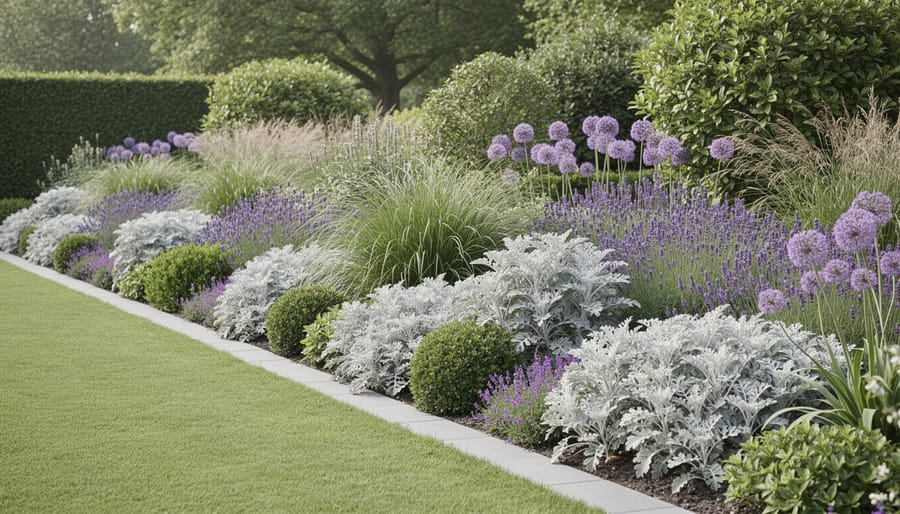
The first technique I swear by is using grey plants as the structural backbone of my borders. Rather than treating them as afterthoughts, I position plants like artemisia ‘Powis Castle’, lavender, and cotton lavender (santolina) as the foundation that holds everything else together.
These silver anchors work brilliantly because they create visual rhythm along the border’s length. I plant them in groups of three or five at regular intervals, which gives the eye somewhere calm to rest between bursts of colour. When my roses and salvias are screaming for attention in June, those steady grey clumps prevent the whole bed from looking chaotic.
In my front border, I planted ‘Hidcote’ lavender every metre along the edge. Behind them, I tucked in taller artemisia at the back. This grey framework stays attractive from April through October, while the plants between them can come and go. When spring bulbs fade or summer perennials flop, the silver structure keeps the border looking intentional rather than patchy. It’s transformed how cohesive my planting schemes feel.
2. Companion Planting with Grey
I discovered the transformative power of companion planting with grey quite by accident. I’d planted a clump of purple catmint next to some silver stachys, and the combination stopped visitors in their tracks. The grey foliage didn’t just sit alongside the purple, it amplified it, making the flowers appear almost luminescent.
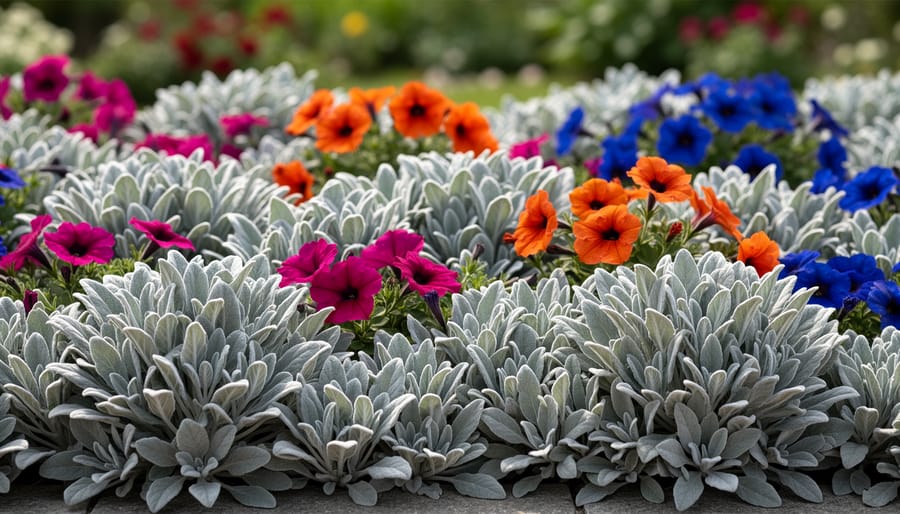
Grey plants are exceptional companions because they act as visual amplifiers. Place silver artemisia beside deep pink roses, and suddenly both elements sing. The grey reflects light onto the petals whilst the pink provides the drama the silver needs to avoid looking washed out.
My most successful pairings combine soft grey foliage with jewel tones. Lavender-grey santolina against magenta geraniums creates electric contrast. Silver curry plant (Helichrysum italicum) paired with burgundy dahlias offers sophisticated depth. For softer schemes, I love lamb’s ear beneath pale pink phlox, the fuzzy silver leaves make the flowers appear to float.
The trick is balance. Use grey as roughly one-third of the planting, letting the colour dominate whilst the silver ties everything together and prevents clashing.
3. Drought-Tolerant Grey Schemes
Three summers ago, I transformed a parched, sun-baked corner of my garden into a thriving grey oasis that barely needs watering. Mediterranean grey plants are perfectly adapted to survive on minimal moisture, making them ideal for our increasingly unpredictable UK summers.
I started with a foundation of lavender and artemisia, adding statuesque verbascum for height and low-growing stachys byzantina to carpet the ground. The key was preparing the site properly: I mixed in plenty of grit to improve drainage, then topped everything with a generous layer of gravel mulch. This mimics their native habitat and keeps roots cool while preventing moisture loss.
The transformation was remarkable. While neighbouring beds wilted during last summer’s dry spell, my grey scheme looked effortlessly elegant. Ballota pseudodictamnus, with its rounded silver leaves, became my star performer, thriving where other plants struggled. I’ve since learned that following RHS drought-resistant guidance helps identify which grey plants genuinely tolerate dry conditions versus those that simply look Mediterranean.
The beauty is that once established, these plants actively prefer neglect. Overwatering ruins their compact form and dulls that silvery bloom. It’s gardening that rewards laziness.

4. Texture Layering
Last summer, I stood back from a newly planted grey border and realized something was off, despite having silver foliage throughout, it looked oddly flat. The problem wasn’t colour; it was texture. I’d planted mostly feathery artemisia varieties without considering how they’d blur together.
Texture layering transformed that disappointing border into something genuinely compelling. I added fuzzy lamb’s ear at the front, its soft, touchable leaves creating an immediate tactile invitation. Behind it, I kept the feathery artemisia for its delicate, lacy quality. Then came the game-changer: architectural cardoon at the back, its bold, sculptural leaves providing dramatic structure. Suddenly, the eye had somewhere to travel, moving from soft to delicate to bold.
The secret is combining at least three distinct textures in any grey planting. Pair velvety plants like Stachys byzantina with finely cut senecio, or contrast the needle-like foliage of lavender against broad-leaved helichrysum. Run your hand along these plants when selecting them, if they all feel similar, they’ll likely read as monotonous from a distance, regardless of their individual beauty.
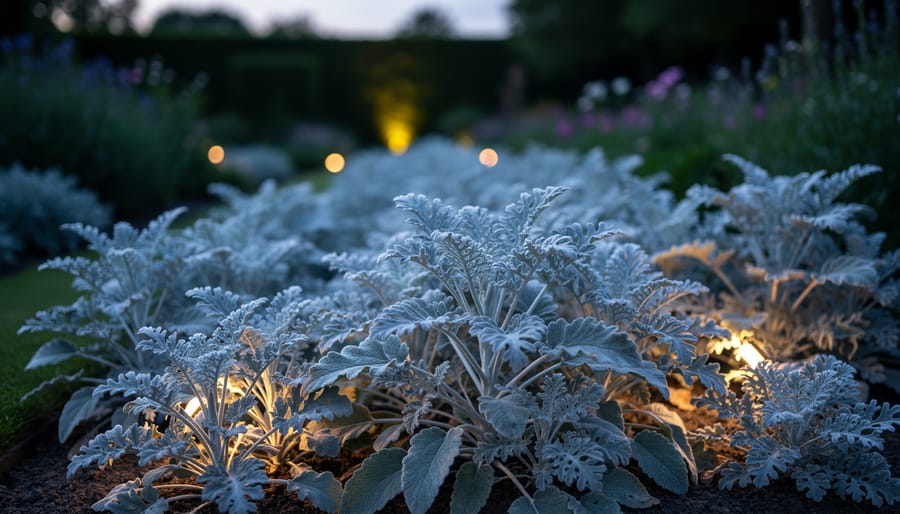
5. Moonlight and Evening Gardens
I stumbled onto this technique by accident during one particularly lovely June evening. I’d stepped outside with a glass of wine just as the light was fading, and suddenly my border of silver artemisia and lamb’s ear seemed to be emitting its own soft glow. It was magical, and it completely changed how I thought about planting.
Grey and silver foliage has this remarkable ability to catch and reflect even the dimmest light. As dusk settles, when most garden colours fade into darkness, these plants seem to brighten. The silvery hairs on their leaves act like tiny mirrors, capturing moonlight and the last rays of sunset to create an almost luminous effect.
For the best evening glow, I’ve found that plants with the palest, most reflective foliage work wonders. Stachys byzantina catches every bit of light with its fuzzy silver leaves. Artemisia ‘Powis Castle’ creates soft, glowing mounds. Senecio cineraria, with its deeply cut silver foliage, adds structure that remains visible long after the sun sets. I’ve also planted Convolvulus cneorum, whose silver leaves and white flowers practically shimmer in twilight.
Position these plants where you’ll see them from windows or seating areas at dusk, and prepare for pure enchantment.
6. Grey as a Cooling Element
I learned this technique by accident when I planted a towering verbascum between two clashing rose beds, one coral, one magenta, and suddenly they made sense together. Grey foliage acts as a visual buffer, absorbing and softening intense colours that might otherwise fight for attention.
When you’ve planted a border full of hot oranges, reds and yellows that scream for dominance, threading in grey plants like stachys, senecio or dusty miller creates breathing room. The silver tones cool the temperature of the whole scheme without diminishing the vibrancy of individual flowers. It’s rather like adding cream to strong coffee.
I use this cooling effect deliberately now. Between my crocosmia ‘Lucifer’ and scarlet dahlias, clumps of artemisia ‘Powis Castle’ provide gentle separation. Where my cottage border transitions from fiery kniphofias to soft blue salvias, a drift of lavender foliage eases the shift.
Grey plants also create restful pockets in busy gardens. A simple grouping of lamb’s ear and ballota can turn a chaotic corner into a calming focal point where your eye can rest before moving on.
7. Year-Round Grey Structure
I learned the value of year-round grey structure during my first proper winter as a gardener, when most of my borders looked disappointingly bare. The grey plants I’d chosen for summer effect had either died back or turned brown, leaving muddy gaps where beauty once lived.
Now I focus on evergreen grey plants that hold their colour and form through frost and rain. Certain lavenders (particularly the French types like ‘Grosso’) keep their silvery foliage all winter, providing structure even when not flowering. Helichrysum petiolare maintains its felted silver leaves right through cold months, though I learned to give it some shelter from harsh winds. Senecio cineraria, commonly called dusty miller, stays beautifully architectural through winter, its lacy grey foliage often looking even more striking against frost.
The real revelation came when I planted santolina and ballota in strategic spots. Their tight, grey mounds act as evergreen punctuation marks, anchoring the garden when everything else retreats. In January, when colour is scarce, these permanent grey structures catch winter light and remind me that the bones of a garden matter as much as its flowers.
Common Grey Gardening Mistakes to Avoid
I learned about grey gardening’s pitfalls the hard way, and my biggest blunder was going overboard with silver plants in one border. What I thought would be elegant and cohesive turned into a washed-out, monotonous stretch that looked more dreary than dramatic. Grey plants work brilliantly as accents and foils for colour, but plant too many together and you’ll create a dull, lifeless space that lacks the visual punch these beauties are meant to provide. Now I aim for roughly 30-40% grey foliage in any scheme, letting them enhance rather than dominate.
Another mistake that cost me several plants was ignoring drainage requirements. Most grey-leaved plants evolved in Mediterranean climates and hate sitting in soggy soil, yet I initially planted them in my heavier clay beds without amendment.
The third trap is assuming all grey plants tolerate shade. I planted several lavenders under a tree thinking their silver foliage would brighten the spot, but they became leggy and failed to flower. English lavender needs full sun to thrive, as do most artemisias, santolinas, and other grey garden favourites. A handful of grey-leaved plants like lamium manage partial shade, but they’re the exception. Check each plant’s light requirements before positioning them, because a struggling grey plant loses its silvery sheen and defeats the whole purpose.
Getting Started with Grey Gardening
When I first decided to embrace grey gardening properly, I felt a bit overwhelmed by all the possibilities. But here’s what I learned: you don’t need to redesign your entire garden overnight. Start with just three or five grey plants tucked into an existing border where you have good light and decent drainage. Watch how they perform through a full season before you expand.
For your first foray, stick with reliable performers that forgive beginners’ mistakes:
- Lamb’s ear, nearly indestructible and loved by everyone who touches its fuzzy leaves
- Lavender, classic, fragrant, and widely available at any garden centre
- Artemisia ‘Powis Castle’, feathery texture and bulletproof in most UK gardens
- Sage, culinary and ornamental value in one plant
- Dusty miller, provides soft, silvery contrast in beds or containers
Spend time observing how sunlight moves through your garden at different times of day. Grey foliage catches and reflects light in ways you won’t notice until you really look. I discovered a previously dull corner of my garden transformed into something magical simply because the afternoon sun hit a clump of artemisia at just the right angle. Don’t be afraid to experiment with pairings either. Pop a grey plant next to something you already grow and see what happens. Some combinations will surprise you in the best possible way.
Frequently Asked Questions
I’ve fielded countless questions about grey gardening over the years, both in my own garden tours and from readers. Here are the ones that come up most often, with answers drawn from my own trial-and-error experience.
Do grey plants need poor soil?
Many grey-foliaged plants thrive in lean, well-drained soil because they’ve evolved in Mediterranean climates, but “poor” is misleading. They need drainage more than poverty, average garden soil works fine if it doesn’t stay waterlogged.
Can grey plants grow in shade?
Most silver and grey plants need full sun to maintain their distinctive colouring. In shade, they tend to turn greener and lose that luminous quality we’re after, though a few like lamium can tolerate partial shade.
How do I keep grey plants looking their best?
Trim them back after flowering to maintain compact growth and prevent them getting leggy. I’ve learned that a light prune in spring encourages fresh silver growth, and deadheading keeps them tidy without much fuss.
Do grey plants attract wildlife?
Absolutely. Lavender and catmint are magnets for bees and butterflies, while the dense foliage of artemisia provides shelter for beneficial insects. My grey border buzzes with life from May through September.
The beauty of grey gardening is that once you understand these basics, the plants largely look after themselves. I’ve found them remarkably forgiving compared to fussier perennials, which is partly why they’ve become such stalwarts in my garden over the years.
items
Based on years of experimenting in my own beds, here are the grey-foliaged stalwarts I return to again and again:
Lavender (Lavandula angustifolia)The classic grey garden plant, offering aromatic foliage, gorgeous flowers, and year-round structure. I have ‘Hidcote’ lining my path.
Lamb’s Ear (Stachys byzantina)Impossibly soft, silvery leaves that children (and adults) can’t resist touching. Mine edges a sunny border beautifully.
Artemisia ‘Powis Castle’Feathery, lace-like foliage that adds incredible texture. It’s my go-to for filling gaps with elegance.
Santolina (Cotton Lavender)Neat mounds of finely-cut grey foliage that hold their shape brilliantly. Perfect for edging or dotting through borders.
Helichrysum italicum (Curry Plant)Narrow silvery leaves with a distinctive scent. Provides evergreen winter interest when little else looks good.
Cardoon (Cynara cardunculus)Architectural drama with massive, sculptural grey leaves. My specimen commands attention from across the garden.
Each brings something different to grey gardening schemes while remaining reliably hardy in UK conditions.
Looking back over these seven techniques, I’m struck by just how versatile grey gardening truly is. Whether you’re creating a drought-tolerant haven, crafting a luminous evening retreat, or simply using silver foliage to make your favourite colours sing, there’s a grey gardening approach that’ll work for your space and style.
The beauty of these techniques is that you don’t need to implement them all at once. Start with one, perhaps the silver border foundation if you’re redesigning a bed, or companion planting if you’re looking to refresh an existing scheme. My own garden has evolved gradually, technique by technique, and each addition has brought unexpected joy.
I’d genuinely love to hear about your grey gardening adventures. Have you discovered a brilliant plant pairing I haven’t mentioned? Perhaps you’ve created an evening garden that glows at dusk, or solved a tricky hot spot with Mediterranean greys? Share your experiences in the comments below, your insights might inspire another gardener’s next project.
These simple techniques have transformed how I see my garden, revealing subtle plays of light and texture I’d never noticed before. I hope they do the same for you this season.